|
System
BioSal®: Combined chemical-biological cleaning of exhaust
air from mechanical-biological waste treatment plants
With various
treatment processes of biogenous and other organic wastes (e.g.
mechanical-biological waste treatment, sewage sludge drying,
anaerobic fermentation, pig/chicken farming) beside VOC and
smell-intensive substances partly larger quantities ammonia
within concentration range up to 600 ppm are emitted into
atmosphere.
The company
BioSal Anlagenbau GmbH - among other products specialised in
production of closed container biofilter units and dynamic
composting plants - offers combined exhaust air treatment systems
for purification of NH3-containing air for a
throughput range from 100 m³/h up to > 50.000 m³/h.

Fig. 1
Configuration example of a modular BioSal® exhaust air treatment
plant
These systems
usually consist of several module-like linked individual
components:
p
Condensate separator
p
BioSal®-AMMON
scrubber with high performance filling materials and one or more
scrubber stages and possibility of an on-line pH registration for
direct acid / chemical dosage or liquid / product draining
p
BioSal®-FIL
container biofilter from stainless steel or corrosion proof
steel, alternatively in hook elevator execution, filled with
layers of different exhaust air-specific filter materials
p
BioSal®-FIL-S
biofilter/bioadsorber with high adsorption capacity incl.
BioSal®-SUB-S
biofilter substrate for selective NH3 adsorption
p
BioSal®-UV exhaust air sterilisation module with UV-C
radiation sources
p
Clean air stack
p
External
or integrated frost and sound-protected BioSal® functional unit
with system electrical engineering, ventilator(s), switching and
control board including SPS control.
The selection of
the appropriate system combination depends with consideration of
the official laws as well as local and economic conditions mainly
on the raw gas parameters
* Ammonia
concentration
* Smell load
* Concentration of
further pollutants
* Dust content
* Input temperature
* Input humidity
and the
appropriate target parameters.
In almost all
exhaust air stream with very high input humidities the
application of an upstream condensate separator is recommend in
order to prevent on the one hand dilution effects of the washing
liquid (BioSal®-AMMON scrubber) and on the other hand
wetness pilot zones in the BioSal®-FIL biofilters.
The target of the
wash process in the BioSal®-AMMON scrubber is it to let
ammonia in the exhaust air react in presence of sulfuric acid to
ammonium sulphate:
2
NH3 + H2SO4 à (NH4)2SO4
After scrubbing
the prepurified and conditioned exhaust air can be cleaned e.g.
with the help of a BioSal®-FIL biofilter system by
further pollutants and smells.
During conversion
process the concentration of (NH4)2SO4-solution
increas and concentrated (NH4)2SO4-solution
can be removed from the process.
A further use of
the (NH4)2SO4-solution as liquid
fertilizer (e.g. for oil fruits and other plants with high
Nitrogen and Sulphur demand) or a mixture with liquid manure for
the improvement of the Nitrogen content is possible.
Beside the
product (NH4)2SO4 no further secondary
or waste products results.
All components of
the BioSal®-AMMON scrubber are made from stainless steel
and high-quality plastics and frequently together with the system
fans installed in a compact frost-protected and sound-absorbing
external functional unit.
With the help of
an on-line pH electrode configuration in a special flow assembly
succeeds a delay-free determination of the respective pH value
and over a metering and dosage station the optimal adjustment of
the necessary H2SO4 concentration.
That ensures that
only as much H2SO4 is supplied to the
respective scrubber cycle, as according to the Input-NH3-Konzentration
absolutely necessary.
Thus e.g.
concentration peaks in the raw gas can be reliably intercepted,
while with very small NH3-Konzentration no significant
consumption of H2SO4 takes place.
The acid dosage
(96% H2SO4) comes with magnet dosing pumps
usually directly from commercial 1.000 l tanks (exchangeable
after emptying - e.g. SCHUETZ® containers).

Fig. 2
Modular BioSal®-AMMON scrubber
The compact BioSal®-AMMON
scrubber can be integrated due to its modular structure also
problem-free into already existing exhaust air treatment plants.
For installation
only water supply and electric power supply are necessary.
Beside the
scrubbing of NH3-/H2S-containing exhaust
air various BioSal® scrubbers can be operated with special
absorber fluids, e.g. organic washing liquids for scrubbing of
VOC containing air.
For recycling
and/or sterilisation of exhausted scrubber/humidifier water we
offer our BioSal®-REWA wastewater recycling technology.
The
scrubber/conditioning stage following BioSal®-FIL
biofilter (closed containers, alternatively hook elevator
execution) are module-like structured and can be problem-free
subsequently extended according to the exhaust air rates.
The sides of the
biofilters are completely manufactured from stainless steel or
from multilayer coated corrosion proof steel. The retaining
structure of the BioSal®-FIL biofilter container usually
consists of colorcoated steel.
The combined
support grid for filling material and air distribution is
corrosion-resistant. Special internals at the edge of filter
prevent a "breaking through" of the incoming air.
The BioSal®-FIL
Biofilter can be filled with different filter materials. The BioSal®-SUB
standard biofilter material is brought in layers into the
biofilter and consists of: wood chaff, dynamically manufactured
substrate and barks.
These tried and
tested substrate combination ensures an optimal settlement
surface for pollutant-diminishing micro organisms, high
population densities as well as a good water reservoir ability
and makes the necessary trace elements available.
The input of the BioSal®-SUB
biofilter material occurs in such a way that pressure drop is
very low.
The service life
of the BioSal®-SUB filter material amount to at least 2
years.
The natural
ageing of the material is caused by sintering and microbial
decomposition. Used biofilter material is free from poison or
pollutants and can be problem-free disposed after use.


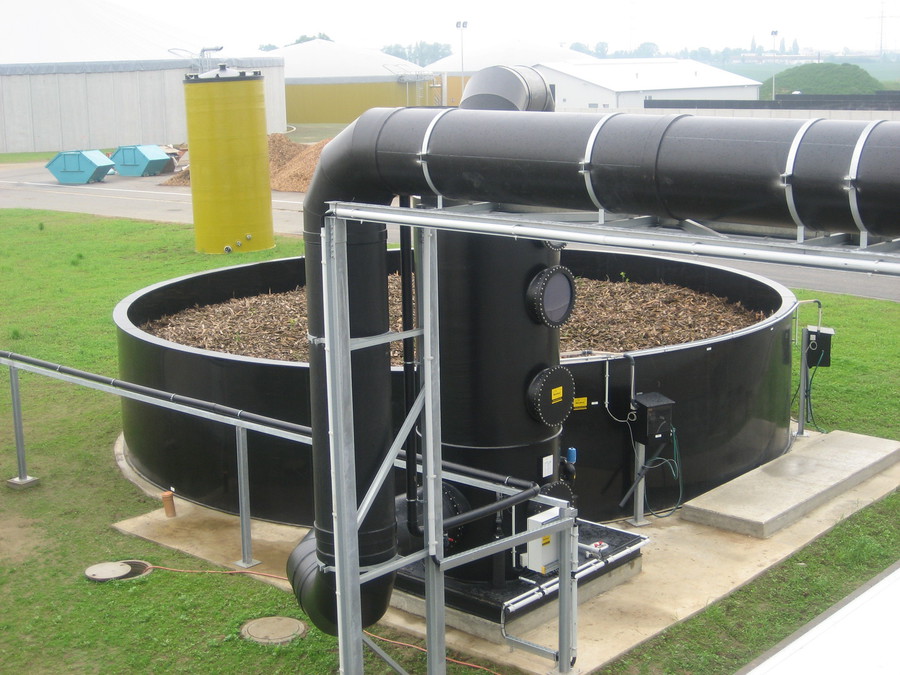
Fig. 3
BioSal®-FIL biofilter container as part of a modular BioSal®
exhaust
air treatment plant
Usually the
microbes adapt after an adaptation time of approximately 2-3
weeks of the respective contamination of the exhaust air stream.
Beyond that an
initial inoculation of the bio filter material with an bioactive
nutritive solution is possible.
Beside our
standard BioSal®-SUB biofilter material we offer
different part-synthetic organic and also multicomponent
biofilter material.
With certain
applications or operation or weather statuses it can come on the
part of the emission sources briefly to increased pollutant
concentrations (concentration peaks), which can break through the
standard biofilter bed in weakened form.
The installation of
a BioSal®-FIL-S biofilter/bioadsorber with high
adsorption capacity downstream into the BioSal®-FIL
biofilter plant ensures reliable interception of such
concentration peaks.
The service life
of the used BioSal®-SUB-S biofilter material with high
adsorption capacity usually is thereby above that of the standard
BioSal®-SUB biofilter material.
In the next years
the germ situation / biological degree of purity of the cleaned
exhaust air will come to public interest.
For this reason
we offer already today the compact air sterilisation system BioSal®-UV,
which can be connected problem-free at the outlet side the BioSal®-FIL
biofilters. For the air germ reduction in the modular BioSal®-UV
system Hg low pressure emitters are used, which emit mainly UV
light of the wavelength 253,7 Nm.
This part of the
UV spectrum steps with DNA-code of micro-organisms in a
photochemical interaction and destroys the cell nucleus and the
genetic information.
When desired for
preliminary tests a combined exhaust air treatment system,
consisting of exhaust air condenser, BioSal®-AMMON
scrubber, BioSal®-FIL biofilter (static or dynamic
operation mode), BioSal®-FIL-S biofilter/bioadsorber with
high adsorption capacity and BioSal®-UV air sterilisation
reactor for throughputs up to 3.000 m³/h is put to interested
users at their disposal.
Advantages
of the combined BioSal®-AMMON scrubber / BioSal®-FIL biofilter
exhaust air
treatment system:
p
Modular
structure of components enables gradual system extension or
implementation into already existing exhaust air treatment
plants. For system extension only electric power and fresh water
supply are necessary.
p
Good
tolerance in relation to in quantities and pollutant
concentration strongly varying raw gas flows as well as against
high dust and moisture loads.
p
Small
power requirement / favourable operating cost: Compared with
thermal exhaust air treatment systems a comparatively
substantially smaller specific primary energy entry is necessary.
Contact:
BioSal Anlagenbau GmbH / Fed. Rep. Germany
Fax.:
++49 / 34345 251 53
e-mail:
sattler@biosal.de
Internet: www.biosal.de
|