|
Information about ammonia-scrubber
D. Sattler, J. Sattler, R. Schneider
Combined exhaust air treatment for
biowaste treatment processes
With different biowaste treatment processes
(e.g. mechanical-biological waste treatment, handling of sewage
sludge, anaerobic fermentation) beside smell-intensive substances
partial larger quantities of NH3 are emitted into
atmosphere.
In Germany at present no legal emission
limits for NH3 in exhaust air are established (1. Dt.
Allgemeine Verwaltungsvorschrift z. Bundesimmissionsgesetz:
Technische Anleitung zur Reinhaltung der Luft [TA-Luft]).
In special cases for mass streams up from
0,3 kg/h e.g. pig stables an official limitation of NH3
emission to 30 mg/m³ is possible.
The company BioSal Anlagenbau GmbH /
Germany - specialised in production of closed container
biofilters, dynamic composting plants and plants for industrial
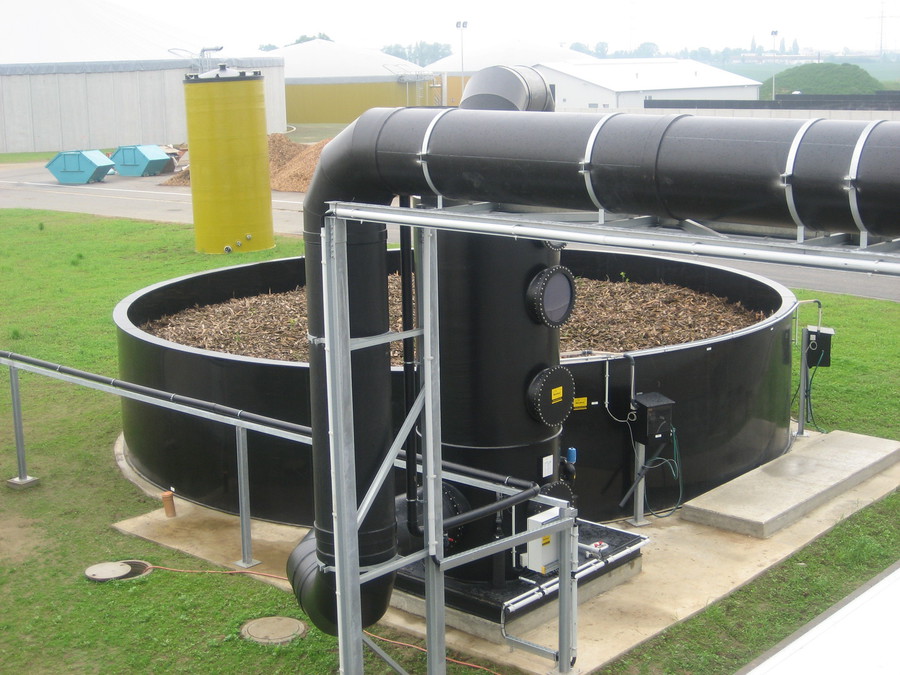
water recycling - has developed a compact BioSal®-AMMON
two-stage scrubber with high performance filling materials for
purification of NH3-containing exhaust air and for the
increase of the efficiency of downstream biofilter units.


The aim of the wash process is it to let
ammonia in the exhaust air in presence of sulphuric acid react to
ammonium sulphate:
2 NH3
+ H2SO4 à (NH4)2SO4
After the wash process the prepurified and
conditioned exhaust air can be cleaned e.g. with the help of a BioSal®-FIL
biofilter system by further pollutants and smells.
During conversion process the concentration
of (NH4)2SO4-solution increases
and concentrated (NH4)2SO4-solution
can be removed from the process.
A further use of the (NH4)2SO4-solution
e.g. as liquid fertilizer (e.g. for oil fruits and other plants
with high Nitrogen and Sulphur demand) is possible.
Beside the product (NH4)2SO4
no further secondary products or wastes result.
All components of the BioSal®-AMMON
scrubber installed in a compact functional unit are made of
stainless steel and high-quality plastics.
With help of an on-line pH electrode
configuration in a special flow assembly and a metering and
dosage station succeeds a delay-free determination of the
respective pH-value and an optimum H2SO4
concentration.
That ensures that only as much H2SO4
is supplied to the respective scrubber cycle, as in accordance to
the Input-NH3-Konzentration is absolutely necessary.
Thus e.g. concentration peaks in the raw
gas can be reliably intercepted, while with very small NH3-Konzentration
no significant consumption of H2SO4 occurs.
The BioSal®-AMMON scrubbers reach
ammonia absorption performances up to 98 %.
The controlling of the operating-friendly
and noiseless system takes place automatically with a PLC process
control. The PLC is equipped if necessary with a long-distance
data transmission for the monitoring and controlling of the
system parameters.

Picture 1 Schematic diagram of a
two-stage BioSal®-AMMON scrubber
The compact BioSal®-AMMON scrubber
can be integrated due to its modular construction problem-free
into existing exhaust air treatment systems.
For assembly of the equipment only a fresh
water / power supply and in any cases a strip-foundation are
necessary.
Interested customers can use on loan a
combined BioSal®-AMMON scrubber / BioSal®-FIL
biofilter system (throughput up to 3.000 m³/h) for preliminary
tests.
|